Preset:
Calculate Time-Based Units with the Grid
(2024-06-10)
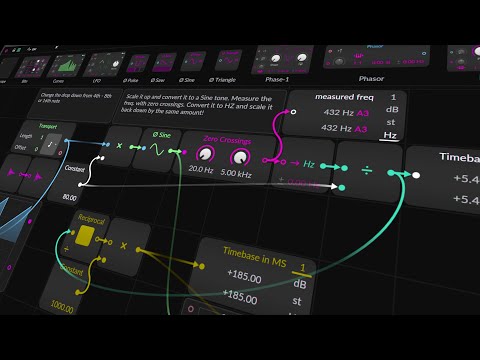
In this video, the creator demonstrates how to use Bitwig's Grid to solve the problem of converting millisecond-based compressor release times to beat-based units like 1/16th or 1/8th notes. This involves using the Grid to calculate time-based units that adjust automatically with changes in BPM. Here’s a quick overview of the process:
Key Points:
- Compressor Plus Limitation: Typically uses milliseconds for attack and release times.
- Beat-based Units: Using note values for release times can ensure consistency across BPM changes.
- Grid Calculation: - Set up an FX Grid with Compressor Plus. - Use the transport to generate a ramp signal that reflects BPM changes. - Convert the ramp signal into a sine wave and measure its frequency using the zero crossings method. - Calculate the milliseconds from the frequency.
- Implementation: - Multiply the phase signal to adjust pitch and use zero crossings to estimate frequency. - Convert hertz to milliseconds using reciprocal calculations. - Modulate the compressor's release time with this value.
Detailed Steps:
- Set Up Grid: - Use FX Grid, add Compressor Plus, and pass audio through.
- Generate Ramp Signal: - Use the transport module to create a ramp signal reflecting BPM.
- Convert Signal to Frequency: - Transform the ramp signal to a sine wave and measure frequency via zero crossings.
- Calculate Time: - Convert frequency (Hz) to milliseconds using mathematical operations (reciprocal and multiplication).
- Modulate Release Time: - Map the calculated milliseconds to the release time of the compressor, adjusting for the logarithmic nature of the control.
This approach, although complex and a bit "hacky," allows for dynamic adjustment of compressor release times based on BPM, ensuring more musical and consistent results.
- BPM2MS Calculator Website:
Basic Support